Solar Orbiter is an ESA-led mission with strong NASA participation. The spacecraft will perform unprecedented close-up observations of the Sun from high-latitudes, providing the first images of the uncharted polar regions of the Sun.
During nominal science operations, science data will be downlinked for eight hours during each communication period with the ground station. Additional eight-hour downlink passes will be scheduled as needed to reach the required total science data return of the mission. The Solar Orbiter ground segment will make maximum reuse of ESA’s infrastructure for Deep Space missions:
- The ground stations, which belong to ESA’s space tracking station network (ESTRACK)
- The Mission Operations Centre (MOC), located at ESOC, Darmstadt, Germany
- The Science Operations Centre (SOC), located at ESAC, Villanueva de la Cañada, Spain
- The communications network, linking the various remotely located centres and stations to support the operational data traffic
The objective of the mission is to perform close-up, high-resolution studies of the Sun and its inner heliosphere. The new understanding will help answer these questions:
- How and where do the solar wind plasma and magnetic field originate in the corona?
- How do solar transients drive heliospheric variability?
- How do solar eruptions produce energetic particle radiation that fills the heliosphere?
- How does the solar dynamo work and drive connections between the Sun and the heliosphere?
Timeline And Status
- April 2012: €300 million contract to build orbiter awarded to Astrium UK
- June 2014: Solar shield completes 2 week bake test
- September 2018: Spacecraft is shipped to IABG in Germany to begin the environmental test campaign
- February 2020: Successful launch
Trajectory
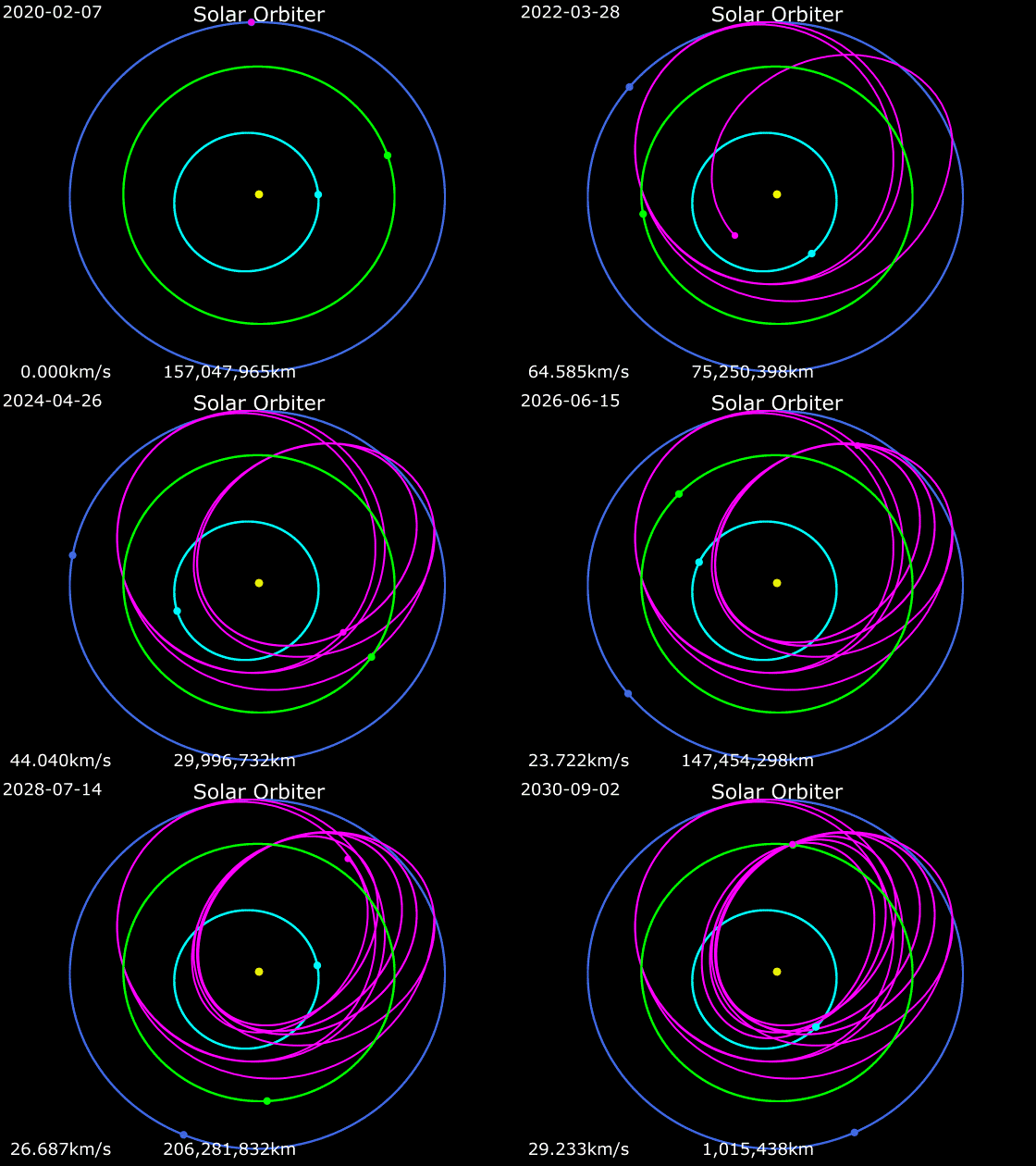
After launch, Solar Orbiter will take approximately 3.5 years, using repeated gravity assists from Earth and Venus, to reach its operational orbit, an elliptical orbit with perihelion 0.28 au and aphelion 0.91 au. The first flyby will be Venus in December 2020. Over the expected mission duration of 7 years, it will use additional gravity assists from Venus to raise its inclination from 0° to 25°, allowing it a better view of the Sun’s poles. If an extended mission is approved, the inclination could rise further to 33°.

 Infinite Physics